MPMAJOR GENERALMilinda PeirisBeyond Rank · Official Biography
6&7

Chapters 6 & 7 · pp. 215–319

Beyond the Call of Duty

Redefining Leadership in Service of the Nation

The true measure of command lies not in battles won alone, but in institutions built to serve the nation long after the guns fall silent.

The battlefield had tested his courage. The years ahead would test something larger: whether a soldier could transform institutions — and leave them stronger than he found them.

When Maj Gen Milinda Peiris arrived at KDU as Vice Chancellor, an appointment he had never expected, he entered a very different arena of service. What followed was an ambitious transformation: new faculties and academic structures, civilian day-scholars studying alongside officer cadets, expanded infrastructure, a Southern Campus, and the decisive beginnings of Sri Lanka’s only University Hospital. KDU was being reshaped from a defence academy into a comprehensive national university.

Yet his military journey was not over. He would rise to Chief of Staff, the second-highest office in the Sri Lanka Army, before retiring after thirty-six years of service.

And even retirement would not be the end of the story.

From 28 December 2008pp. 224–231

From Battlefield Experience to a Faculty of Medicine

Why Medicine Came First

General Sir John Kotelawala Defence University

He had seen at first hand what timely medical care meant to a wounded soldier. At KDU, that experience helped shape one of his earliest priorities.

When Maj Gen Milinda Peiris assumed duties as Vice Chancellor on 28 December 2008, KDU’s academic establishment was still small — fewer than fifteen academics formed its nucleus — and the institution stood at the threshold of transformation.

Among Milinda’s earliest and most consequential priorities was Medicine. Years of operational service — and his own near-fatal battlefield injury — had given him a soldier’s understanding of the importance of skilled medical care. Establishing a Faculty of Medicine at a defence university meant overcoming institutional resistance, finding academic partners, recruiting expertise and building almost everything from the ground up.

The beginnings were remarkably modest. At one stage, the fledgling faculty operated from a single room. Yet within a few years it had moved into a modern purpose-built complex and was attracting distinguished academics, developing regional links and securing professional recognition.

What began as an answer to a military need would grow into something much larger — and eventually lead Milinda towards an even more ambitious idea: a university hospital of KDU’s own.
2008–2016pp. 215–288

From Defence Academy to National University

Building a University

Ratmalana · Werahera · Southern Campus

One faculty became many. One campus reached beyond Ratmalana. And a university built primarily for the armed forces opened its doors to the nation.

Medicine was followed by Engineering and a widening academic architecture encompassing Defence and Strategic Studies, Law, Management, Social Sciences and Humanities, Computing, Allied Health Sciences, Graduate Studies and, at the Southern Campus, Built Environment and Spatial Sciences.

But perhaps the most consequential change was not a building at all. KDU opened its degree programmes to civilian day-scholars, bringing young civilians into classrooms alongside officer cadets and redefining the University’s national role.

The physical footprint expanded too, from Ratmalana to Werahera, where more than fifty acres were secured for an ambitious medical complex, and southwards to Sooriyawewa, where construction of the Southern Campus began in 2014. At Werahera, fifteen acres were allocated for a University Hospital that would eventually become an 814-bed tertiary-care teaching hospital, including 63 ICU and HDU beds.

In seven years, KDU had ceased to be defined simply by what it had been. The foundations of a comprehensive national university had been laid.

18 October 2013pp. 279–281

From Ratmalana to Buckingham Palace

KDU on the World Stage

Buckingham Palace, London

International recognition was not the objective. Building an internationally connected university was.

Under his leadership, KDU expanded academic and institutional partnerships across Europe, North America, Asia, Australia and Africa, while staff were encouraged to pursue postgraduate study, fellowships and professional training overseas. The KDU Research Symposium was transformed into an Annual International Research Conference.

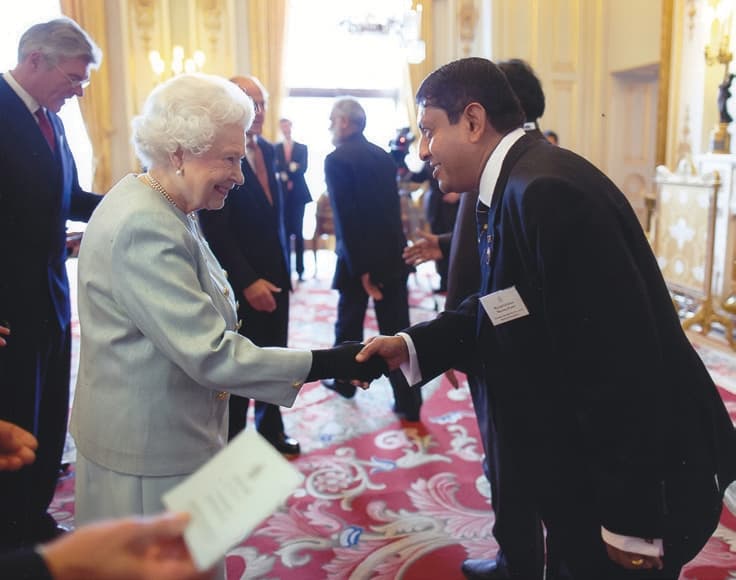
One memorable moment came in October 2013, when Milinda attended the Association of Commonwealth Universities Congress in England with Vice Chancellors from across the Commonwealth. As part of the programme, the delegates were hosted at Buckingham Palace by Queen Elizabeth II.

Recognition followed. In July 2014, he received the Award for Outstanding Contribution to Education from the World Chancellors and Vice Chancellors Congress, followed on 23 July 2015 by the Education Leadership Award from the World Education Congress.

KDU was no longer looking only inward. The university at Ratmalana was beginning to find its place in a much wider academic world.

From the book’s photographs, no. 181: Queen Elizabeth II greeting Milinda Peiris at Buckingham Palace, 18 October 2013.
18 OCTOBER 2013

From the book’s photographs, no. 181: Queen Elizabeth II greeting Milinda Peiris at Buckingham Palace, 18 October 2013.

12 February 2016pp. 302–305

47th Chief of Staff

Second in the Army

Army Headquarters, Colombo

The Army’s second-highest office had once been within reach. When it finally came, he returned to it from the university he had been asked to stay and build.

The appointment might have come nearly three years earlier. In August 2013, when Gen Daya Ratnayake became Commander of the Army, Milinda had been identified as the officer to take over as Chief of Staff. But Secretary of Defence Gotabaya Rajapaksa believed Milinda’s continued leadership of the University would be of greater long-term value.

When asked whether he wanted the Army appointment, Milinda’s answer was characteristically brief: ‘Sir, that is your decision.’ He remained at KDU.

On 12 February 2016, after nearly seven years transforming the University, Maj Gen Milinda Peiris finally returned to the Army as its 47th Chief of Staff, the first Nalandian and the seventh cavalry officer to hold the second-highest office in the Army.

Six months later, after thirty-six years in uniform, the cavalryman came home to his regiment. The Sri Lanka Armoured Corps carried him in farewell on a Saladin Armoured Car, while brother officers and men lined the street and sent him off with three cheers.

2020–2023pp. 307–319

Returning to Take KDU Further

A Second Call to Serve

General Sir John Kotelawala Defence University · Sri Lanka Scout Association

Retirement had closed one chapter. Then came an unexpected invitation to return to the institution he had helped transform, and lead it through a very different age.

Milinda returned to KDU for a second tenure as Vice Chancellor in 2020. Then came COVID-19, followed by economic and political upheaval. Through those difficult years, KDU continued to develop its academic and institutional structures while looking increasingly outward. In 2023, KDU became the first Sri Lankan university to reach the final eight of the Times Higher Education Awards Asia in the Leadership and Management Team of the Year category.

One moment gave visible national recognition to that journey. On 25 August 2022, President Ranil Wickremesinghe conferred the President’s Colours and University Colours on KDU, one of the highest honours in the institution’s history.

At the same time, another circle in Milinda’s life was closing. The boy who had become Nalanda College’s first President’s Scout in January 1978 was appointed Chief Commissioner of the Sri Lanka Scout Association on 2 January 2020.

More than four decades separated the President’s Scout from the Chief Commissioner. Between them lay the soldier, the battlefield commander, the diplomat, the Vice Chancellor and the Chief of Staff. The thread connecting them was service.